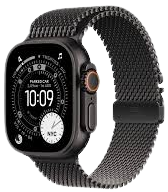
Apple Watch Ultra 3 Price in Nepal
Full specifications
Editor’s review
- Dual-band GPS L1+L5 for Himalayan trekking: Ordinary GPS watches use the L1 band, which struggles in deep valleys, narrow gorges, and terrain with tall ridges on either side — exactly the landscape on routes to Annapurna Base Camp, Everest Base Camp, and Langtang. L1+L5 dual-band GPS cross-references two satellite frequencies, delivering dramatically better accuracy in these challenging environments. For serious trekkers, this is the most meaningful GPS specification on any Apple Watch.
- 72-hour battery in Low Power Mode: Multi-day high-altitude treks mean limited or no power access. Ultra 3 in Low Power Mode can last 72 hours — enough to cover most popular multi-day routes like Poon Hill (3 days) or Ghorepani–Phediya without charging. Standard mode at 42 hours covers most day-trekking itineraries comfortably.
- Satellite messaging for Nepal's remote terrain: Ultra 3 adds 2-way satellite messaging — a genuine safety feature when trekking in regions where mobile coverage drops entirely (above Namche Bazaar, Thorong La, remote Mustang). This requires a satellite service subscription (Garmin inReach equivalent), but it's the only Apple Watch that can communicate without any cellular or Wi-Fi signal.
- 100m water resistance for monsoon and river crossings: Nepal's monsoon (June–September) brings heavy rain and swollen rivers. WR100 + EN13319 means Ultra 3 handles river crossings, heavy monsoon downpours, and white-water rafting on the Trishuli without concern.
- 86dB siren for search and rescue: The Ultra 3's built-in 86dB siren can be activated to signal your location to search and rescue teams. In Nepal's mountain environment, where helicopter rescues and SAR operations are not uncommon, this is a potentially life-saving feature.
- No Nepal Apple service — insure this device: At its price+, the Ultra 3 is a significant investment with no authorised repair path in Nepal. Consider third-party travel or gadget insurance if trekking in remote areas.
Key Highlights
| 📺 Display | LTPO3 OLED Always-On, 1.98", largest Apple Watch display |
| 🔋 Battery | Up to 42h standard (72h Low Power Mode) |
| 📍 GPS | Dual-band GPS L1+L5 (precision-grade) |
| ❤️ Health | ECG, HR, SpO2, skin temp, depth gauge, hypertension alerts |
| 💧 Water | 100m (WR100) + EN13319 dive standard + IP6X |
Key specs — what they mean
Pros & cons
- Serious trekkers, mountaineers, and trail runners who need precision GPS in Nepal's complex Himalayan terrain
- Adventurers who want emergency satellite communication capability when hiking above mobile coverage zones
- Open-water swimmers, divers, and rafters who need 100m water resistance and a built-in dive computer
- Casual fitness trackers or city users u2014 the its price+ price is unjustifiable if you're not using the outdoor and rugged features regularly
- Anyone who doesn't need standalone GPS or satellite messaging u2014 Apple Watch Series 11 at its priceu201390,000 covers the health and fitness bases for far less
Compare with similar smartwatches
Alternatives to consider
Warranty & service
Frequently asked questions
The satellite hardware is present in the Ultra 3, but the messaging service (similar to Apple's Emergency SOS via satellite) requires network activation in your region. As of 2026, confirm current Nepal service availability before relying on this feature in the field u2014 satellite service coverage is expanding but not universal. Carry a dedicated satellite communicator (Garmin inReach) as backup for remote expeditions.
Yes u2014 with the Oceanic+ app, Ultra 3 functions as a recreational dive computer (EN13319 certified) to 40m. For trekkers who travel abroad for diving or use it for Nepal's lake swimming and river activities, this is a genuine multi-sport tool. It tracks depth, dive time, surface interval, and water temperature.
Both use multi-band GPS (L1+L5) for improved accuracy in complex terrain. Garmin's advantage remains battery life u2014 a Fenix 8 can last 16+ days in smartwatch mode vs. Ultra 3's 42 hours. For multi-week expeditions or unsupported long treks, Garmin holds an edge. For treks of 3u20135 days with access to some charging (teahouses on popular routes), Ultra 3's satellite messaging and watchOS integration make it a compelling alternative.